
What's the Deal with UMD-PG?
This is a link to a specific revision of this blog post, of which there are 2. Specifically, this revision was posted on 2024-04-15. To see all revisions, click here.
This article talks about eroge (porn games) for the PSP, though no explicit content is shown or discussed.
The PSP was released at an interesting point in time. Initially released in 2004, it was sold in English-speaking territories not just as a console but as a “convergence device”, that unified multiple devices into one bit of hardware, far beyond what other devices were doing at the time. It had unparalleled multimedia support, including movie/TV playback, and it also played actual video games! Some were even at PS2-level graphically fidelity. Strangely, others were closer to what we now see as an app than an actual game. Even more interestingly, people sold porn for the PSP, and the ways in which eroge managed to make its way onto the platform while avoid traditional games classification is really interesting.
There’s a lot of this aspect of the PSP that hasn’t been written about in-depth in English, even in earlier versions of this article! The version you’re reading right now is essentially a brand new write-up, though you can read the older revision at the link above. This version adds additional comparisons to Japanese phones and similar things which were done on DVD. This is an ever-growing attempt to contextualise this aspect of the PSP in one place, and maybe we’ll even figure out what the fuck UMD-PG actually means along the way.
Table of contents:
- The DS vs. The PSP
- The PSP as a Media Device
- Everyone Else Plays Catch-up
- What The Fuck Does UMD-PG Mean
- Footnotes
The DS vs. The PSP
While the PSP is our main focus here, I don’t want to just jump in to describing UMD-PG cold turkey. If that’s the only thing you want to read about, the table of contents is up there. I think it’s important to understand why it exists though, because there’s more to this than just laughing at an oddity. So, I want to talk about other contemporary devices. This includes the DS, which I’m going to talk about a lot for an essay that is ostensibly about the PSP, but that’s because I think it serves as an interesting contrast!
We can see this contrast in how these consoles were announced that their respective press conferences at E3 2004, as well as the differences between their design ethos. The DS announcement presentation got a lot of hype from the audience, and that’s probably because of Reggie Fils-Aimé’s stage presence, as well as Nintendo selling it as a game console first and foremost. They announced its wireless capabilities, but the focus of this was about playing with other consoles, and not any kind of web browsing or using any non-game applications. Once consumers as got their hands on the DS they learned that it barely had a system menu at all! It freezes if you take a DS cartridge out while you’re in it, and if you want to go back to the main menu from the system settings or Pictochat you have to restart your console.
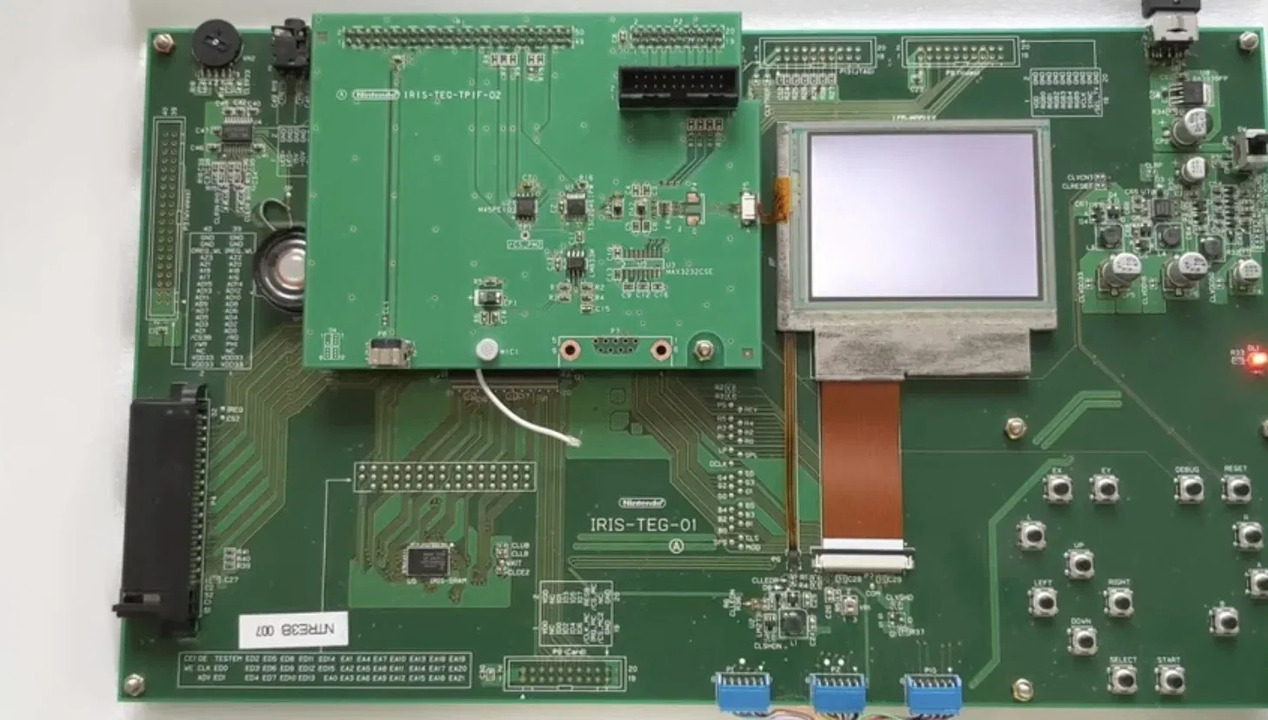
The DS was only ever made to play video games, and not to be a unifying device. For proof, let’s look at Nintendo’s Project Iris. This was the code name for their intended successor to the GBA, before the DS (which had the codename Project Nitro) started development. The Iris shared a lot of the same hardware to the DS, but didn’t have the second screen or touch/wireless capabilities.1
We did not see a release of Project Iris: work on it was scrapped when Project Nitro was conceived, after a discussion between the higher-ups at Nintendo. Specifically, Hiroshi Yamauchi (former president of Nintendo and honourary advisor on the project) gave a suggestion to Satoru Iwata: give the Iris 2 screens, mimicking the old Game & Watch dual screen consoles.
The general manager in Nintendo’s Research and Engineering division at the time was Satoru Okada, and he had a big hand in the development of the DS, along with many other Nintendo handhelds. He was interviewed in the British magazine Retro Gamer, specifically in issue 163, talking about the development of Project Iris. Quoting the interview, starting from comments by Okada:
“The project was moving forward at a good pace but during the development, something unexpected happened.”
That something turned out to be Sony’s PSP and it was getting Nintendo very worried. Although Hiroshi Yamauchi, who was only involved on the IRIS project as an honorary advisor, he was worried about the next Game Boy. He had a telephone conversation with Nintendo’s then-president, the late Satoru Iwata, about his idea, which was then relayed to Okada. “President lwata then came to see me,” Okada recalls. “He was obviously bothered and he said: ‘I talked to Yamauchi-san over the phone and he thinks your console should have two screens… A bit like the multi-screen Game & Watch, you see?’”
So even when Nintendo was directly responding to the PSP, they didn’t attempt to make a device that focused on anything other than video games: they added dual screens, extra buttons, wifi connectivity, and toy-like software such as Pictochat.
Nintendo was adopting a blue ocean philosophy at the time. They let Sony and Microsoft focus on the competitive heavily-hostile section of the gaming market, pushing technology as far as possible. Instead, Nintendo focused on catering to a new market that was underserved: casual gamers. This is the philosophy that governed their Wii and DS era, and it did very well for them! They sold consoles for cheaper and achieved market dominance that way, and selling it a profit at launch (in contrast to how other more cutting-edge console hardware launched breaking even or at a loss)2 meant they still made money off of people who never played anything beyond the Wii Sports pack-in. You can read more about this philosophy in my posts about Streetpass and Wappy Dog (a DS game that came with a toy robot). Here’s a quote grom IGN’s coverage of an interview with Yamauchi from 2004 where he talks about this philosophy:3
“I have been saying this for some time, but customers are not interested in grand games with higher-quality graphics and sound and epic stories,” he said. “Cutting-edge technologies and multiple functions do not necessarily lead to more fun. The excessively hardware-oriented way of thinking is totally wrong, but manufacturers are just throwing money at developing higher-performance hardware.”
So, the PSP at E3 2004 is exactly that higher-performance hardware that Yamauchi was talking about. Within the first few sentences, Kaz Hirai (head of Sony Computer Entertainment America at the time) compares the PSP to a broader range of mobile devices, such as “cell phones, digital music devices, productivity tools, and gaming machines.” It had PS2-like graphics! The press conference dedicates time to showing video playback on their device, at a resolution of 480x272 on a 4.3-inch screen. He didn’t describe it as a “convergence device” but it definitely fits the bill. It had an OS and system menu that wasn’t barebones, and you could navigate back to it without restarting your device. It wasn’t just a game console, because it could play music and video, let you read comics, connect to the internet, and do all sorts of other things with peripherals that were released later such as a GPS accessory and even a TV tuner!
When I originally wrote this, I (quite embarrassingly) didn’t bring up the disparity between the features available for mobile phones in Japan and mobile phones elsewhere. Simply put, Japanese mobile phones were much more feature-rich than anywhere else in the world at this point in time. Colloquially they were called “garakei”, whose name evoked the divergent evolution of life on the Galapagos Islands. Some of them could make contactless payments via NFC as early as 2004, and apparently some could stream digital TV as early as 2005!4 The “convergence device” term I use here doesn’t make as much sense in Japan because these devices already unified a lot of stuff. However it appears in contemporary English tech writing from all over the Anglosphere, or at the very least from the USA, where phones were not yet unifying everything into one device. Even the iPhone didn’t make a big splash when it first released in Japan, because it was locked out of the existing garakei ecosystem, and it only picked up steam once it replaced or reintroduced features that already existed there (which is why we have emoji now, for example). However, the PSP still had an advantage over any of these devices in both regions, namely in terms of video game hardware and on-demand video playback.
No company at the time had a monopoly on devices that can do so many things portably in both regions and this was key to Sony’s strategy. It might look like the PSP was the jack of all trades and master of none. It wasn’t attempting to court new audiences, but appeal to existing highly-competitve ones with low margins: it had to compete with game consoles, music players, portable DVD players, and more, and it also had to compete with Japanese keitai in those areas, which had features that the PSP would never get like NFC contactless payments.
However, Sony was the only one that could make a console like this because of all of the intellectual property they owned. Obviously the Sony Group doesn’t just make games and hardware: Sony Music Entertainment is currently one of the biggest music labels in the world. They were already making money through licensing the distribution of music that they themselves had not made, the storage formats that contained them, and the devices that played them. They made the Walkman! This type of thing was not new to them! In addition to owning and licensing many music and video works and distribution channels, they had control over distribution for the storage formats that contained PSP games and UMD VIDEO.
When the Playstation Store made its way to the PSP in the post-horse armour world of 2008, microtransactions came with it. I remember Disgaea 2 for the PSP specifically having microtransactions for individual characters, for example. Despite this, they were already planning for that as early as 2004.
In the same E3 press conference where he announced the PSP, Hirai talks about how online experiences that don’t generate revenue is “the norm, but not for long,” and mentions that the future is in “mini transactions,” listing things like downloadable content, episodic extensions, and user generated content. When he mentions “a multitude of opportunities for downloadable entertainment content,” we know what he means. The writing was on the wall, even then. Digital media can be whatever price they choose and they can take whatever cut they want.
In other words: The DS wanted to be a video game console that sold to as many new people as possible, whereas Sony’s ambition for the PSP was to surpass every garakei while also encompassing basically everything the iPhone was doing 3 years before it was even announced and position themselves as vital to the ecosystem so they could own it and take a cut from all of it. The PSP was a console that could only exist in the specific time it was released, before the iPhone and Android devices had both caught up in Japan and swallowed the “convergence device” market whole in the USA, and this lead to some interesting choices from both Sony and Nintendo.
The Universal Media Disc
So what does the PSP do differently to be that fabled “convergence device”? There’s a few things, but this article focuses on one of them: their proprietary disc medium, the Universal Media Disc, or UMD.
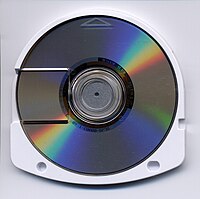
A UMD can hold about 1.8 gigabytes, and as the name “Universal Media Disc” suggests they don’t hold just games! Movies and music were also distributed via UMD early in the PSP’s lifecycle. The UMD in its plastic case visually resembles the Minidisc, another storage medium created by Sony specifically for music.
By 2001, the Minidisc was suffering as MP3 players (and MP3 piracy) started to take off, so Sony took the hint by the PSPs release in 2004: you didn’t see much music released on UMD, though it did exist in some cases. Video piracy on other portable devices was not nearly as common, however, so the main multimedia usage for UMDs was UMD VIDEO, which meant you could buy movies and shows and watch them on the go much more easily.
Interestingly, a UMD could hold multiple different types of media at once. The UMD VIDEO version of the movie Stealth came with a demo for Wipeout that had exclusive content, for example. From what I gather based on topics on the Redump forum5 this is a UMD split into 2 layers/partitions, one of which is for a game and the other for the movie. Some UMD demo discs listed in that discussion had similar structures, and you can see how these appear in the OS in this YouTube video. The PSP system menu has multiple options for games, video, and music, and the UMD is listed separately on each of them. When you hover over each section, it displays different information, as you can see below.
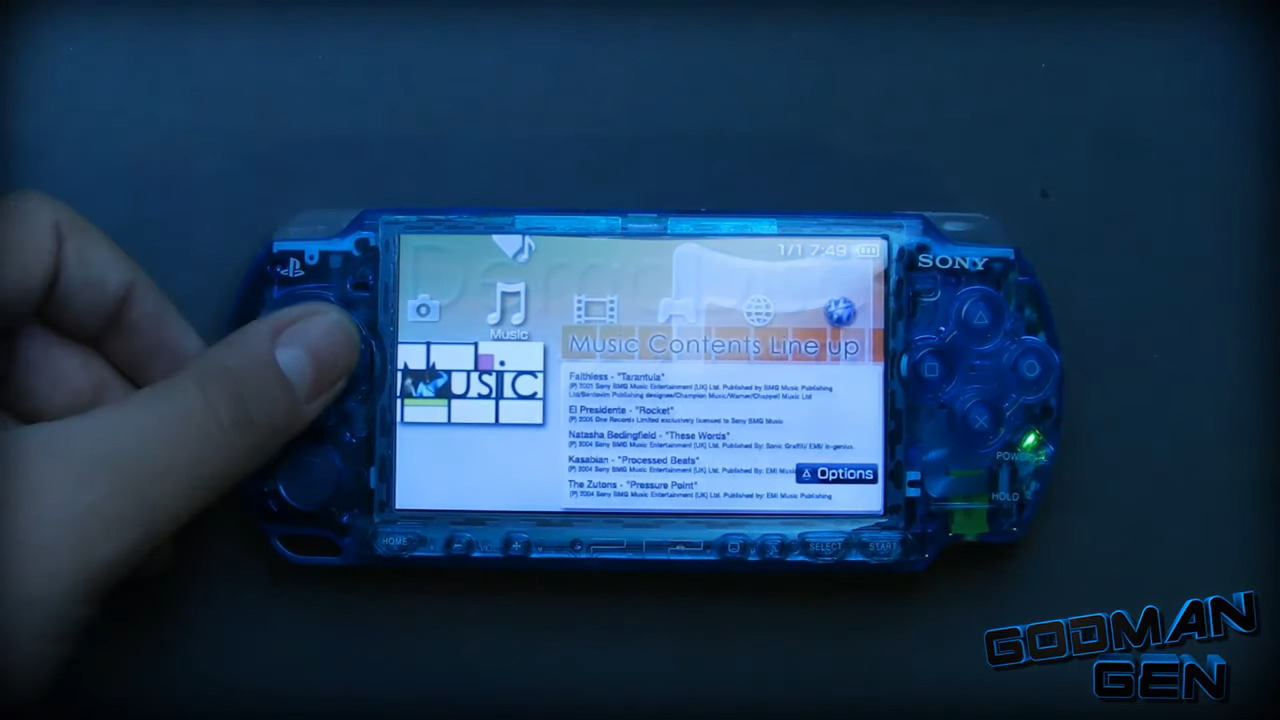
Each of these sections ran in different “modes”. While the PSP was the only device that would ever support UMD, we can imagine someone making a UMD player that only supported music/videos without supporting games.
We can tell that Sony intended for multi-device UMD support not just from what Kaz Hirai said, but also from the fact that UMDs store video at a resolution higher than the PSP can display (although maybe that’s just to allow for video output to plug a PSP into a TV). However, despite that use case for UMDs, the PSP was the only device that supported them. For why that might be, I want to refer to @Modren’s comment on my (now archived) post on Cohost: UMD only makes sense for portable devices, you could use a portable DVD player for your already existing DVD collection, and companies didn’t want to license UMD support from Sony. You also couldn’t buy blank UMDs and there wasn’t any consumer hardware for writing to them. Despite how Hirai talked at E3 2004 about UMD’s potential as a storage medium, releases for UMD media outside of games dropped off quickly.
MP4 For Thee, Not for Me
So why do all this? Why abandon cartridges for discs in a portable medium with the knowledge that they’d be abandoned shortly after? Well, discs were the only portable way of distributing movie-length video in 2004. Online music distribution may have been flourishing then, but online video distribution was basically non-existent. Internet was not good enough for real-time video streaming at this point in time (and was barely good enough for real-time audio, as I mentioned in my big post on Hypnospace Outlaw). YouTube launched in February 2005, whereas iTunes didn’t sell videos until October 2005, and Google Movies only launched in 2011 (before being folded into Google Play shortly after). UMD VIDEO gave people a disc smaller than a DVD but at similar quality, meaning they’re easier to carry around, even if they contain slightly lower quality video and less special features. If you wanted to watch movies and shows on the go at the time and already had a PSP, it was one of your best options until a few years later.
Most non-DVD portable video players at the time (let’s call them MP4 players) had similar flows to portable music players: they let you copy videos to their internal storage, though your video had to have the right format and codec and whatever for your device, which wasn’t standardised at all. While some devices had microphones, cameras, radio antennae or TV tuners and some even let you record media through those, you either had to deal with awful quality or some kind of DRM/copy protection or maybe even both, much like using a PVR device. I imagine that any garakei with video playback functioned similarly, though there aren’t many writings on that in English so I can’t say for sure.
Looking in markets in the USA, the first iPod to support video playback was the 5th generation iPod Classic in 2005. Archon were releasing MP4 players and the like around that time, such as the Gmini 402, Jukebox Multimedia, and AV series. These didn’t have screens or resolutions as big as the PSP, yet they were still considered good devices by American tech writers at the time.6 Even 2008 articles like “The quest for the ultimate convergence device”7 mention the PSP as being in the running for the very thing described in its title. That’s 4 years after its initial release! That’s 1 year after the release of the iPhone!!
Finally, as another point against other devices, David Lynch never said “It’s such a sadness that you think you’ve seen a film on a fucking PSP”, though there was a UMD VIDEO release of Blue Velvet. If only I could burn a UMD of Inland Empire…
This is why the PSP is so interestingly well-timed: it came out late enough to have a good enough screen to watch videos on, but early enough for UMDs to make sense as a video distribution method, before online on-demand online video distribution took off in any region. It really could have only been released in 2004.
What did they put on UMDs?
Anyway, I mentioned eroge for the PSP, but actual porn video was released for the PSP as well. One of the reasons that the VHS format won over Sony’s Betamax format was because adult videos were predominantly on VHS, so porn on UMD as a method of encouraging adoption must have made sense to someone. I don’t know why someone would watch porn on the go like that at the time of its 2004 release but its there! Think about the urge to hurriedly scroll past anything risque when it gets recommended to you while scrolling through social media on public transport; can you imagine being a salaryman watching porn on the train in 2004? It’s a more efficient way of getting sexual gratification than struggling through unofficial Famicom strip mahjong games, at least, though it’s definitely less considerate of nearby people.
This was in multiple regions too! America had 3 adult UMD VIDEO discs released, and Europe had many more, with “La Blue Girl Returns” being an example of an English hentai UMD VIDEO release. Sadly, I can’t play it personally. I don’t have a PSP nor do I have any physical or digital copies of any porn released on UMD, and emulators don’t really support UMD VIDEO either, but we can assume it’s like all other UMD VIDEO releases, where it uses the built-in video player functionality of the PSP.
There was also The Silent Hill Experience, which contained animated digital comics, as well as “music, video, and trailers”. This was specifically a UMD VIDEO release, with no age classification. All of these things are connected via menus, kind of like how DVD menus worked. I wish I had more to say about it but I can’t check it out myself.
Even outside of UMD VIDEO specific things, the PSP had honest-to-god capital A Apps released for it. Passport to Rome is a PSP “game”, except it doesn’t have any age classification. It’s just a travel guide to Rome. There’s other versions of this game that function as travel guides to a few other places in Europe too. I say capital A App because it really does feel like the kind of thing someone would download for an iPhone circa 2008. It doesn’t have any background music or any stylistic flourishes, unlike instructional DS games like Cooking Guide: Can’t Decide What To Eat? or Art Academy. It feels utilitarian. While I’m not going into it much in the interest of time, this game is the impetus for me writing this essay: the fact that something like this exists reminded me about how uniquely positioned the PSP was for developers to treat it this way.
Everyone Else Plays Catch-up
Despite how the PSP was better fit for general-purpose software, the DS had a much wider install base than the PSP, and that install base was more made up of casual gamers. This meant it got a lot more software that strayed away from the traditional definition of game. I’m not going too in-depth here because this essay will never be finished if I do, but some examples are Art Academy and e-book collections and the DS Web Browser, which are closer to software than actual game-y video games. More importantly than that, the DS (and GBA) could also be used as video playback devices, in some weird roundabout ways.
In 2003 Nintendo announced what would become Game Boy Advance Video, which was branding for cartridges that let the GBA play video. However, all of these were of shows primarily for young audiences like Spongebob, and the only movies released in this format were Shrek, Shrek 2, and Shark Tale. GBA cartridges simply didn’t have the space to hold any long amount of video even with its heavy compression. These were also released in… 2004, the year the PSP came out, so the contrast is very stark! If you’re interested, f4mi has a good video about Game Boy Advance Video that you should check out.
It’s also worth comparing GBA Video to the VideoNow, a separate portable video player also aimed at children. The original 2003 device used a bespoke optical disc format called PVD, and had a non-backlit black and white screen of only 80x80 non-square pixels! Only in 2004 did it get a release with a colour screen, with dimensions comparable to the PSP but at the smaller resolution of 240x160 and on much discs that were much larger (physically) than UMDs. At the very least more stuff was released for VideoNow than for GBA Video.
The DS also had DSvision exclusively in Japan, which was similar to GBA Video, except you bought a DSVision cartridge and then bought microSD cards that would slot in to it. You could watch movies and shows and read manga on it, and you could buy new releases online and then copy them onto a microSD card instead of always needing to buy physical media. Needless to say, this was pretty cumbersome when you consider that removing the cartridge to swap out the microSD cards would require restarting the DS each time! Not a lot of DSvision releases are archived: No-Intro’s database only catalogues 8 releases, though many more were available, because I’ve seen videos of someone playing DSvision releases that haven’t been hashed by them. Because it was a Nintendo service there was most likely no porn released for it. Obviously. I mean come on.
This is to say nothing of the unofficial support the DS received via flash cards like the R4. Some of them had video playback, and could probably play more video formats than the stuff specifically for DSvision, while still being expandable by plugging in a microSD card, which you definitely couldn’t do with a UMD. That’s probably by design, because you can do a lot of weird hacks with cartridges like inserting extra hardware into them that UMDs could never be capable of. Better for Sony’s bottom line, because weird hacks facilitate piracy, but it does make the DS infinitely cooler (and usable if you don’t live in the USA). Point being, if you wanted to use the DS as a media player, your best bet was to wait a few years for the relevant flash carts to be developed and then use those.
There’s other examples we could use here, but it would be too wordy for a post that is meant to be about the PSP. Again, this is about contrast: look at all the weird hacks that had to be done to turn the DS into a media player! Those hacks may be cool, but the PSP… just does that. You can play movies and shows and stuff on it just fine. Wild!
What The Fuck Does UMD-PG Mean
OK it’s time for the inciding incident for this post.
Picture this. I’m in a used game store. I see a copy of Passport to Rome for the PSP and it says on the box that it doesn’t require classification. And then, it reminds me of one thing I had heard offhand, in Hazel’s video on Elfen Lied, where she very briefly talks about the eroge (explicit visual novel) School Days:
School Days is also significant in the realm of PSP archival, because it was released on a super uncommon UMD format, UMD-PG, that was created so that eroge could exist on the platform without them being classified as games within the PSP’s catalogue.
And I start thinking about it again. I get home, watch the video by Hazel again to try and find this clip, and she shows an image like this on screen:
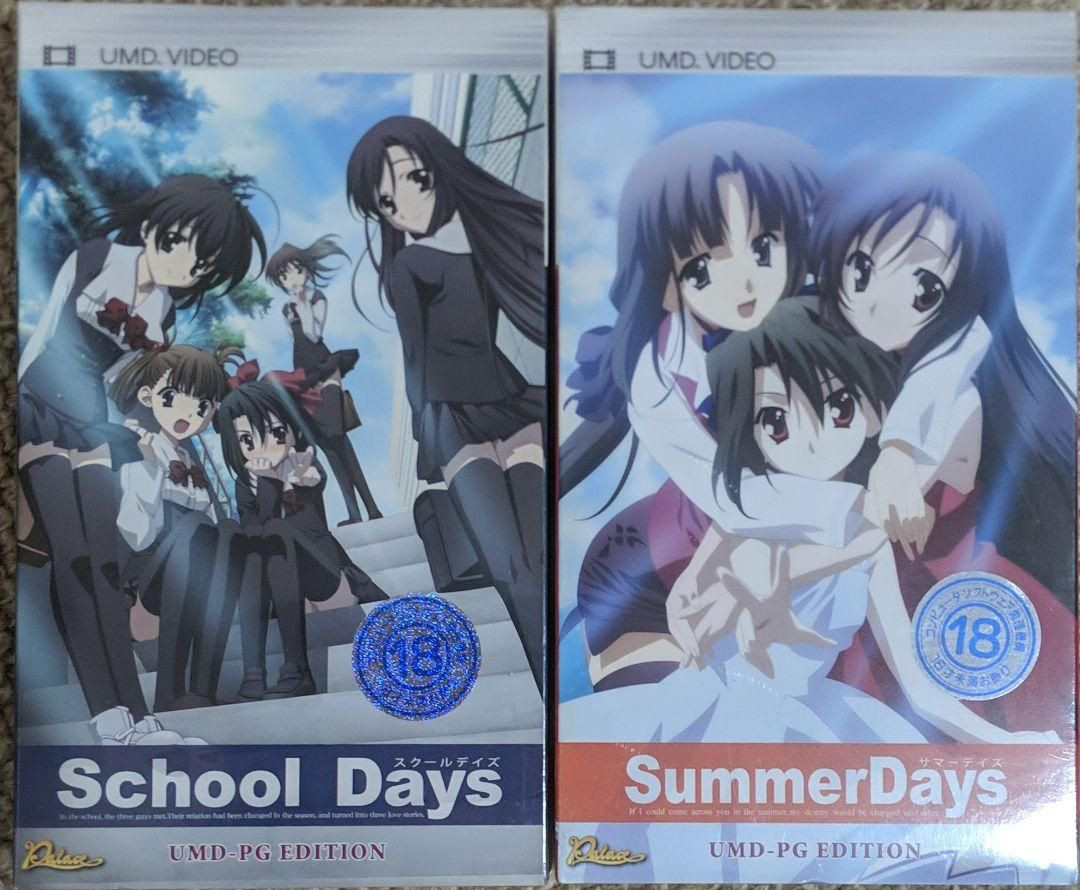
This raises a lot of questions! What’s with the sticker? Why is it a UMD VIDEO??? School Days actually is a video game, not a video, so we are left with a pretty big question:
What the fuck is UMD-PG???
Firstly: The “PG” part of UMD-PG doesn’t mean “porn game”, it means “player’s game.” PG was already used in this way prior to UMDs existing, with formats like DVDPG. Admittedly I didn’t know this when I wrote this post initially, and the phrase “DVD player’s game” should gesture at the true nature of these things, but let’s pretend we’re an English speaking game enthusiast looking this up for the first time right now (as I once was). The literal translation of PG is relatively straightforward yet it raises more questions. It’s a game, yet the box says it’s a video? What the hell do they mean?
As Hazel says in that video, UMD-PG is a super uncommon format. VNDB currently has 56 titles in its database that have a UMD-PG edition,8 and if we check Redump’s page that lists currently undumped Japanese PSP games we can see that there are 50 UMD-PG titles that are undumped.9 For comparison, VNDB lists around 2400 DVDPG games.10 Additionally, most PSP emulators do not support these games, meaning that the only real way that you can play these in the modern day is to track down a PSP and a physical copy of one of these exceedingly rare games (or an ISO of one of the few that have been dumped), which explains why so few people even know what’s up with them.
Even in pretty authoritative places, information is vague at best or confusing and contradictory with no real source at worst. Let’s take a look at this thread on the official forum for JPCSP. This is a PSP emulator that, unlike PPSSPP, attempts to emulate at least a few of the things needed to play UMD VIDEO! Maybe we finally have a concrete answer… except we don’t, really. A senior member describes it as simply playing UMD VIDEO without much elaboration, giving an incorrect impression. A junior member provides more information, comparing it to a Flash game among other things, which isn’t a comparison I would make but it’s a little closer to the truth.
There’s multiple reddit threads and forum threads that have discussions almost exactly like this. People will say one thing, then someone else will say another. Some will talk about “censorship from Sony” and some will talk about age ratings, and almost none will elaborate further, as is the nature of social media. Since there is so little documentation to how any of these UMD-PG games work (if they even are games) it’s impossible to actually determine the truth from these comments. However, I have found some videos that I think make it reasonably clear not just what they are but how they function and how players would have interacted with them.
When it came to playing back movies, UMD VIDEO was a format much like DVD. Which is to say, DVD players had to have some manner of scripting to support DVD menus, and UMD VIDEO was much the same. As far as I can tell, this menu system is the system that powers UMD-PG games.
For some more information, we can look at this comment on GitHub issue #11662 for PPSSPP, which uses this analogy as well as some slightly more technical information. This also matches what the junior member in the JPCSP thread said.
Also, this is basically what DVDPG was! DVDPG is very similar, but it exists for different reasons for UMD-PG. A good PC is a relatively high initial cost for playing 18+ ADV games or visual/sound novels. Again, there was porn on VHS, and that was obviously a huge industry. Even if visual novels are drawn porn more often than not, video players are still a way to get those works into more people’s one free hand. Therefore, some developers of these games released DVD versions of them in order to get it into as many hands as possible, for whatever reason.
While most UMD-PG games have not been dumped, there are a few that have, and a few of those have gameplay that has been uploaded. One of these is a reddit thread asking for more info on a game called Boku Dake no Kajitsu, which appears to be an eroge only released for PSP via the UMD-PG format. If you want to be confused, take a look at its box art:

Those details in the alt text drive me wild. Why does this game say “UMD VIDEO for PSP”? It’s different from basically every other UMD-PG game I’ve seen! Maybe they’d just given up hope that anyone else would license UMD-PG. Who knows…
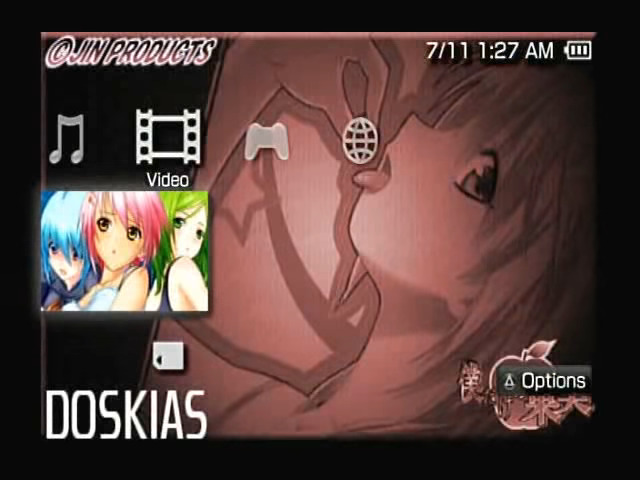
Regardless, in that reddit thread, a commenter linked to a gameplay video on YouTube (please do not mention that you came here from this blog post, it won’t be funny). First of all, the person playing the game selects it in UMD VIDEO mode:
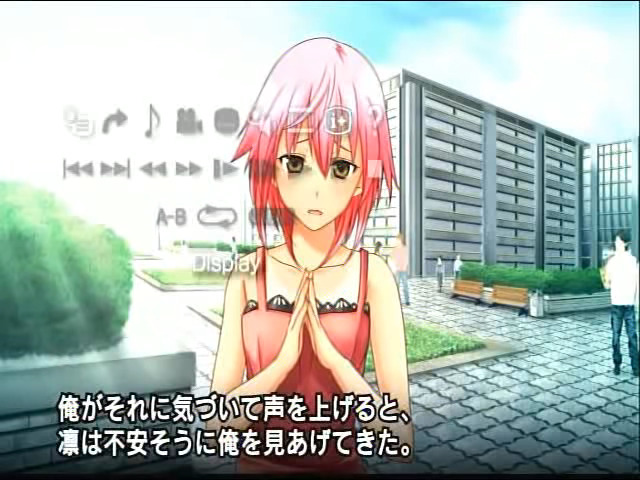
At various points in the video, you can see the PSP video control panel pop up. Most features like play and pause are disabled, but it’s there. In fact, at the very end, you can see it pop up during “gameplay” in which a character sprite and text box are on screen while music plays. Here is an image of that, for posterity:
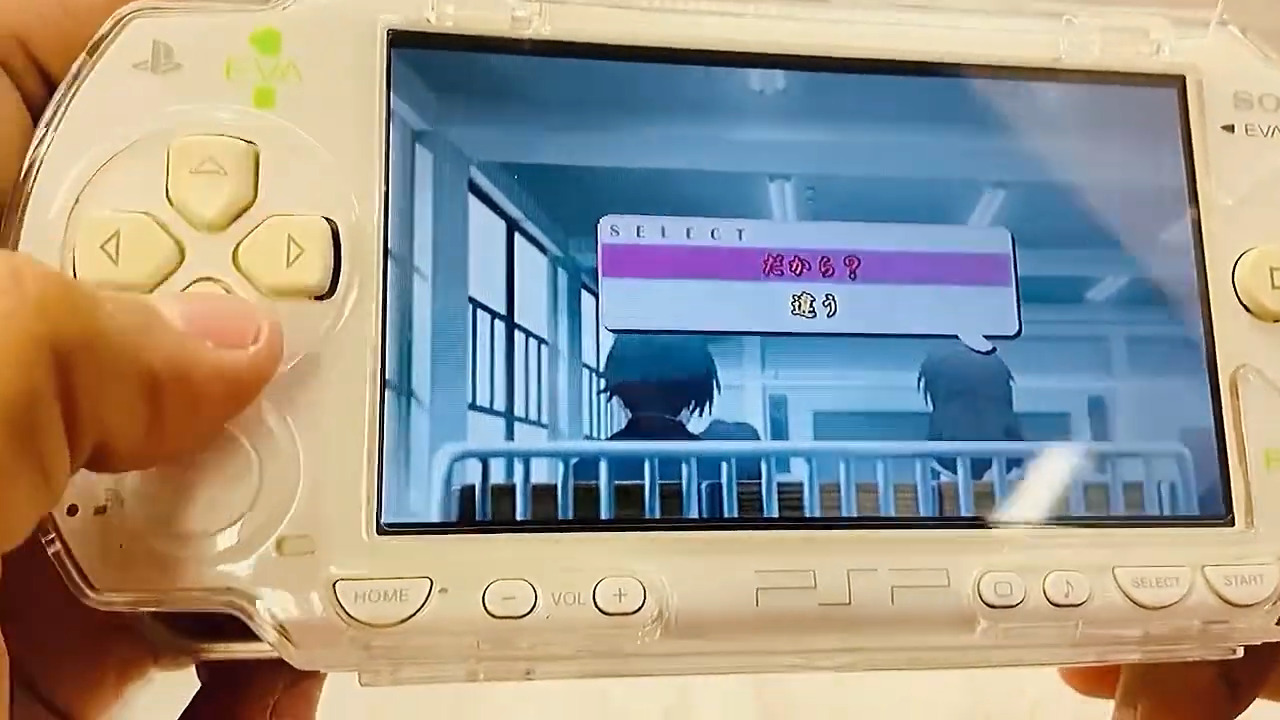
So we have at least part of this solved. UMD-PG games are videos and they run in UMD VIDEO mode, hence the UMD VIDEO branding on the box. But how does the interactivity work? For that, we can fittingly return to the UMD-PG version of School Days. One video shows some additional parts of how UMD-PG games work that we can use to figure out how UMD-PG ports were made. For one, it does have choices available. Again, this is in the video, but I am posting it here for posterity:
According to VNDB, School Days UMD-PG Edition was released on 4 UMDs. This sounds unwieldly as hell, and also makes me ask: if it’s on 4 UMDs, how does it handle swapping between them? Are they utilising some sort of save memory within the PSP? Can UMD VIDEOs even do that? Hell, eroge can be pretty long sometimes, so what’s the save mechanism for these things?
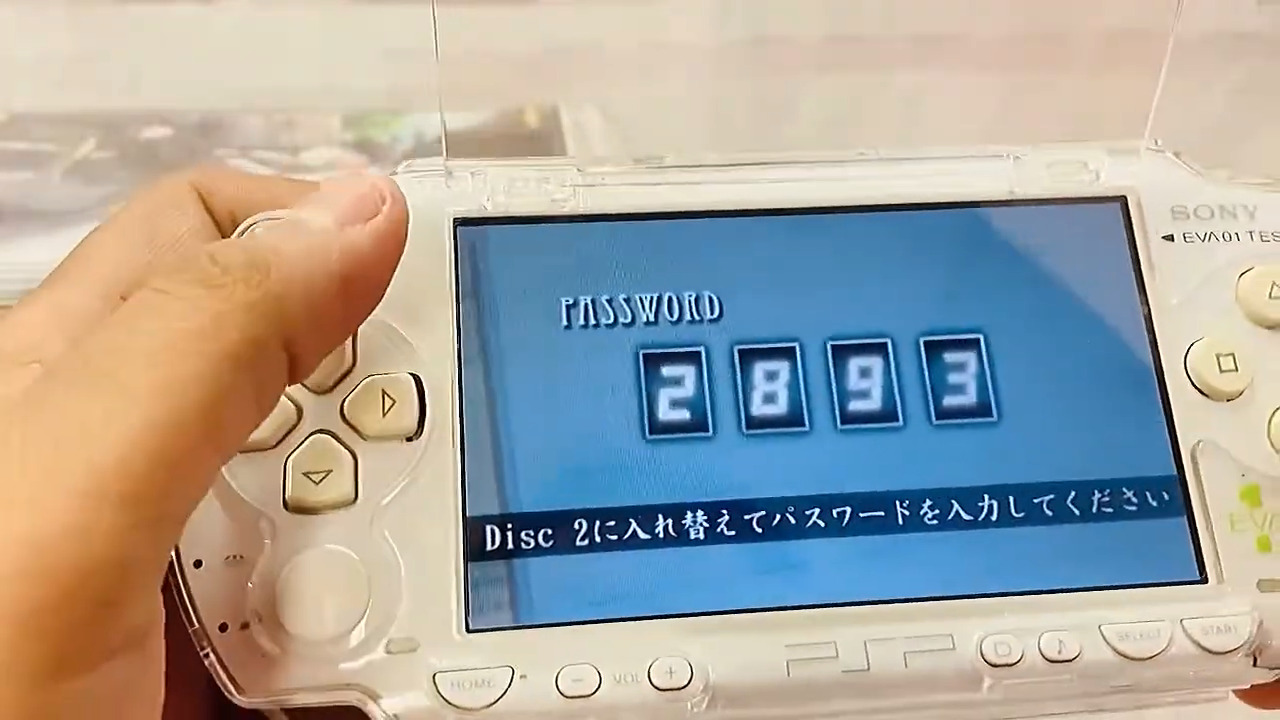
Turns out no, UMD-PG games don’t use save memory, to my knowledge, though I don’t know enough about the PSP to know whether UMD VIDEO mode could use it in general (though I would assume not). In School Days UMD-PG edition, when you would need to swap UMDs, the game shows you a password. Then, when you put the next UMD in, you enter the password, and it takes you to the next scene. Weird! Here is a screenshot of the password menu from that same video about School Days UMD-PG edition:
So there we have it. The gameplay of UMD-PG games is just video playback with no save data, but with some scripting capabilities thrown in to allow for multiple choices and endings.
However, devices with UMD drives obviously weren’t as ubiquitous, so the reason for UMD-PG’s existence is a bit different: UMD-PG games do not need to be rated by video game classification bodies like the ESRB and CERO11 because they are videos! Imagine if the ESRB had to rate every single interactive DVD. Because of this, UMD-PG devs could get away with just slapping an 18+ sticker on the game box to avoid classification from those bodies. This also explains why people talked about “censorship from Sony”: Sony Computer Entertainment wouldn’t want to release games with adult CERO ratings, but these releases are removed enough from video games to allow for pornographic material on the platform without causing a big stink.
I don’t know all of the technical details behind UMD-PG, and I don’t need to because I’m not a PSP homebrew or emulator dev, but hopefully this gives enough of an insight into what UMD-PG means and what the context surrounding it is that people can stop saying whatever they want about it.
In Conclusion
I don’t really have any additional things I want to add here. If I tried to make some grand statement at the end of every blog post it would get old fast and take way too long for me to write everything. I just wanted to share something cool! However, if renpy could add support for exporting a visual novel to UMD-PG format I would like that very much thanks.
Like come on. While I was working on this revision, someone wrote a goddamn SIGBOVIK paper about converting RenPy visual novel (singular) to PDF, but they didn’t even get around to adding backgrounds.12 Surely we can do better. Don’t you want to make it even more impracticable and inaccessible? Lock it to a format that we can’t even write to! With your help, the only winning move can be to not player’s game.
Information on the Iris in this post primarily comes from “Nintendo’s Lost DS Prototype: Project IRIS”, posted to YouTube by Rare Gaming Dump on the 24th of July, 2022. https://www.youtube.com/watch?v=F2FstdEhmRE↩︎
“Analyst: Wii Hardware Gets Nintendo $6 Per-Console Profit”, written by David Jenkins for Game Developer (then called Gamasutra) on the 2nd of December 2008. https://www.gamedeveloper.com/game-platforms/analyst-wii-hardware-gets-nintendo-6-per-console-profit↩︎
“Interview: Hiroshi Yamauchi”, published on IGN on the 14th of February 2004. https://www.ign.com/articles/2004/02/14/interview-hiroshi-yamauchi↩︎
“The Mysteries of Japan-Only Phones”, by Stefania Lehman, published on sabukaru. https://sabukaru.online/articles/the-mysterious-early-world-of-japans-cellphone-culture↩︎
“Archos Gmini400 review: Archos Gmini400” by John Morris for CNET, published on the 23rd of September 2004. https://www.cnet.com/reviews/archos-gmini400-review/↩︎
“The quest for the ultimate convergence device”, by Leigh D. Stark for Cybershack, published on the 19th of August 2008. https://cybershack.com.au/cybershack/the-quest-for-the-ultimate-convergence-device/↩︎
Search for “umd-pg” on VNDB done prior to 2024-04-15: https://vndb.org/r?q=umd-pg;fil=;s=released;o=d;p=1↩︎
retrieved prior to 2024-04-15: http://wiki.redump.org/index.php?title=Sony_PSP_Japan_Missing_Games↩︎
Search for “dvdpg” on VNDB done on 2025-03-24: https://vndb.org/r?q=dvdpg↩︎
I specify video game classification bodies because I’m someone who lives in Australia, and all of our media here is classified through the boot of the nanny-state Australian Classification Board. They refused classification for fucking Disco Elysium. It would classify UMD-PG releases in Australia whether they were technically videos or not. Since the search functionality on the ACB website isn’t great I do not know if any released here, but given that it’s not likely.↩︎
Thapa, Aaron. “Erm… What the SIGBOVIK?” The Association for Computational Heresy (SIGBOVIK) 2025, 2025, 396-401. Available at: https://sigbovik.org/2025/proceedings.pdf↩︎